
Executive Summary: Document Architecture in Free-Zone Trade
Trade and logistics operations within UAE free zones—including JAFZA, DAFZ, DMCC, KIZAD, and regional commercial hubs—handle high daily volumes of cross-border documentation. International suppliers, freight forwarders, and logistics partners transmit commercial invoices, ocean bills of lading, airway bills, packing lists, and certificates of origin across disparate file formats, scanning resolutions, and language combinations. Manual re-keying into enterprise resource planning (ERP), transport management systems (TMS), and trade portals introduces operational friction, processing backlogs, and transcription discrepancies. An event-driven document automation architecture—combining optical character recognition (OCR), structured field extraction, mathematical validation, multi-tier confidence evaluation, and mandatory human review gates—streamlines trade document processing while preserving operational auditability and statutory compliance.
1. Where Document Workflows Break in Free-Zone Operations
Operating a trading, manufacturing, or distribution enterprise across UAE free zones requires orchestrating continuous inbound and outbound international cargo movements. While free zones provide streamlined business formation, tax frameworks, and logistics connectivity, the underlying administrative reality remains heavily document-intensive.
In standard daily operations, a single import consignment arriving at Jebel Ali Port or Dubai International Airport generates a constellation of physical and digital paperwork: a commercial invoice issued by an overseas supplier, a detailed packing list, an ocean bill of lading or airway bill, a certificate of origin, and inspection certificates. These documents arrive asynchronously via varied communication pathways—unstructured vendor email attachments, freight forwarder portal notifications, SFTP batch drops, or mobile messaging scans.
When operations rely on manual handling, recurring friction points emerge across the documentation chain:
- Inconsistent Document Formats: No two overseas exporters structure commercial invoices identically. Column ordering, header placements, tax breakdowns, and total summaries vary widely across international trading corridors.
- Scanned Raster Images vs. Digital PDFs: A significant portion of cross-border documentation arrives as low-resolution raster scans, photographed printouts, or multi-generation photocopies rather than vector-rendered digital PDFs.
- Bilingual Field Layouts & Transliteration: Documents generated across the Middle East frequently combine Arabic and English typography, mixed Western and Eastern Arabic numerals, and non-standardized phonetic transliterations of corporate entity names.
- Repetitive Manual Re-Entry: Operations clerks manually transcribe invoice numbers, container identifiers, Harmonized System (HS) codes, weights, and unit pricing into enterprise resource planning (ERP) databases, warehouse management systems (WMS), and local trade filing extranets.
- Discrepancies Between Packing Lists and Invoices: Quantity totals or line-item descriptions frequently exhibit minor syntax variations between the commercial invoice and the packing list, requiring manual line-by-line reconciliation.
These issues can create manual review and re-entry work when document formats and downstream systems are not standardized. The operational objective is to replace manual copy-pasting with an engineered ingestion, extraction, and validation pipeline.

2. End-to-End Document Automation Architecture
A reliable trade document automation engine is fundamentally an event-driven data processing pipeline. It decouples document reception from backend database commitments, ensuring high resilience during operational volume spikes.
The processing architecture operates through eight sequential stages:
- Multi-Channel Ingestion Gateway: Inbound documents are ingested via monitored email inboxes (IMAP/Microsoft Graph API), secure FTP servers, partner webhook listeners, or object storage buckets (Amazon S3, Google Cloud Storage, or Azure Blob). Upon receipt, the system computes a cryptographic SHA-256 hash of the binary file to establish an immutable idempotency key and detect duplicate submissions.
- MIME & Structural Validation: The ingestion microservice validates file signatures, rejecting corrupted archives, unsupported file types, or password-protected attachments before allocating compute resources.
- Pre-Processing & Multi-Page PDF Splitting: Multi-page consignments—often bundling invoices, packing lists, and delivery orders into a single PDF—are parsed into discrete logical document boundaries using visual separator classification models.
- Optical Character Recognition (OCR) & Text Extraction: Dual-layer OCR engines process both computer-generated text streams and scanned raster images, reconstructing reading order, bounding boxes, and tabular structures across complex layouts.
- Document Type Classification: Machine learning classification models categorize each document into its respective operational schema: Commercial Invoice, Packing List, Bill of Lading, Certificate of Origin, or Customs Declaration.
- Field Extraction & Entity Normalization: Key-value extraction models identify critical business entities and convert dates, currencies, weights, and entity names into standardized canonical schemas.
- Validation Engine & Confidence Evaluation: Deterministic business logic evaluates extracted values against mathematical integrity constraints, internal master data, and historical records, calculating composite field-level and document-level confidence scores.
- Routing Gateway: High-confidence documents with complete mathematical reconciliation transition directly to downstream ERP staging queues. Records containing ambiguities or failing validation rules route to a human-in-the-loop exception queue.
3. Commercial Invoice Field Extraction & Normalization
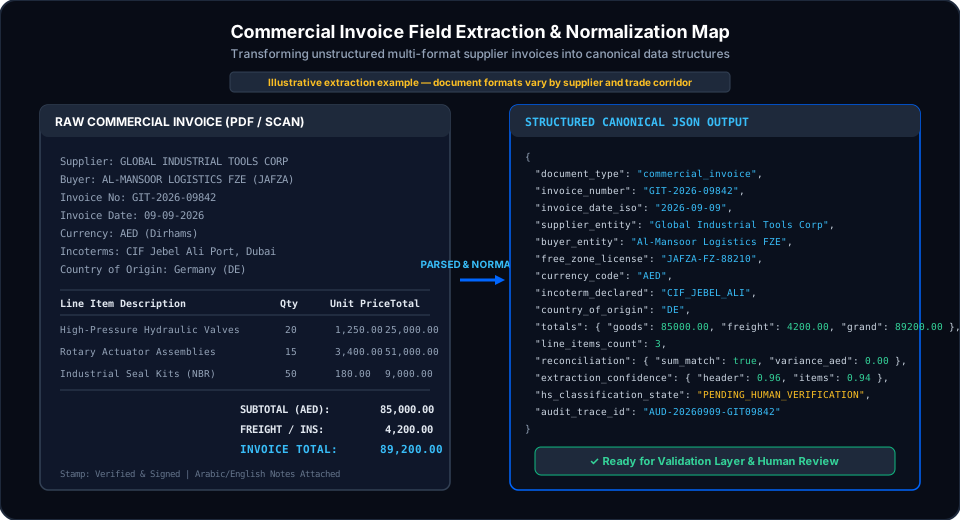
Commercial invoices serve as the foundational financial and commercial instrument in international trade. The automated extraction engine parses both header-level metadata and repeating tabular line items into a structured data model.
Header-Level and Line-Item Entities
Target extraction fields on standard commercial invoices include, where present and legible:
- Invoice Number & Date: Extracted and normalized into ISO 8601 calendar format (
YYYY-MM-DD) regardless of whether the original document uses US (MM/DD/YYYY) or European (DD/MM/YYYY) formatting. - Supplier (Exporter) & Buyer (Importer) Entities: Name, commercial registration or free-zone license number, physical address, and tax registration number (TRN), matched against the company's internal ERP vendor master list.
- Currency Specification: Standardized to ISO 4217 three-letter currency codes (e.g.,
AED,USD,EUR,GBP,CNY), identifying both symbol formats ($,€,¥) and colloquial notations. - Declared Incoterms: Extracted alongside the specified delivery location (e.g.,
FOB Shanghai,CIF Jebel Ali,EXW Munich) per ICC Incoterms 2020 definitions where present and legible. - Country of Origin: Normalized to ISO 3166-1 alpha-2 country codes.
- Tabular Line Items: Line number, supplier part number, commercial product description, quantity, unit of measurement (UOM), unit price, extended line total, and applicable discounts.
- Invoice Totals: Subtotal, freight charges, insurance value, handling fees, value-added tax (if applicable), and final payable amount.
Below is an illustrative internal extraction object demonstrating canonical structure:
{
  "document_type": "commercial_invoice",
  "invoice_number": "INV-EXAMPLE-001",
  "invoice_date": "2026-09-09",
  "currency": "AED",
  "supplier": "Example Trading LLC",
  "buyer": "Example Importer FZE",
  "total_value": 125000,
  "country_of_origin": "example",
  "line_items": [
    {
      "description": "Example industrial component",
      "quantity": 10,
      "unit_price": 12500,
      "hs_code_candidate": null
    }
  ],
  "review_status": "human_review_required"
}4. Packing List & Cargo Manifest Extraction
While commercial invoices represent commercial value, packing lists and cargo manifests describe the physical packaging and consignment dimensions. These documents are vital for free-zone warehouse receiving, container yard gate passes, and inventory staging.
Field schemas differ by operator, document source and business process, but standard extraction models focus on the following physical parameters where present and legible:
- Consignment Identifiers: Bill of Lading (BOL) number, Air Waybill (AWB) number, master consignment reference, and shipping line container numbers (formatted per ISO 6346 container identification standards).
- Package Counts & Types: Total package count, segmented by unit type (e.g., standard pallets, wooden crates, corrugated cartons, intermediate bulk containers, steel drums).
- Weights & Measurements: Gross weight, net weight, tare weight, and volumetric cubic meters (CBM), with automated unit conversion ensuring alignment with ERP inventory records.
- Cross-Document Reconciliation: Automated algorithms correlate line-item quantities on the packing list against the corresponding commercial invoice, immediately highlighting discrepancies such as short shipments or unexpected SKU inclusions.
5. Bilingual Arabic / English Document Ingestion & Optical Challenges
Document automation within the UAE and GCC trade environment faces distinct linguistic and typographic complexities. Commercial paperwork frequently presents hybrid layouts combining Arabic and English text within identical tables or stamps.
OCR and extraction performance varies by scan quality, layout, language mix and model/provider capability. High-performing systems address several technical realities:
- Bidirectional (BiDi) Text Layouts: Ingesting documents containing both left-to-right (LTR) English and right-to-left (RTL) Arabic requires OCR engines that correctly reconstruct logical bounding box reading orders without character inversion.
- Numeric Discrepancies: Documents originating in certain regional corridors may utilize Eastern Arabic numerals (٠, ١, ٢, ٣, ٤, ٥, ٦, ٧, ٨, ٩) alongside standard Western Arabic numerals (0, 1, 2, 3, 4, 5, 6, 7, 8, 9). Automated normalizers convert all numeric values into standardized integer and floating-point formats.
- Transliteration Inconsistencies: Corporate entity names and free-zone designations are frequently transliterated phonetically between Arabic script and Latin characters (e.g., "المنصور" transliterated variously as "Al Mansoor", "Al-Mansur", or "Almansoor"). Systems deploy fuzzy string matching and phonetic indexing (such as Metaphone or Levenshtein distance algorithms) aligned with internal vendor master databases.
- Stamps, Signatures & Security Overlays: Official customs clearance paperwork, chamber of commerce endorsements, and notarized invoices frequently bear circular physical ink stamps, embossed seals, or handwritten signatures overlapping tabular figures. Specialized image segmentation filters isolate stamp artifacts from underlying numerical data prior to OCR execution.
6. HS-Code Assistance — The Strict Legal and Operational Boundary
The Harmonized Commodity Description and Coding System (HS) is an internationally standardized system of names and numbers to classify traded products, maintained by the World Customs Organization (WCO) and enforced by national customs authorities.
Within UAE free-zone trade, declaring correct HS codes is critical for determining customs duty liabilities, statistical tracking, export control compliance, and import restrictions. However, organizations must maintain an unequivocal operational boundary regarding automated classification.
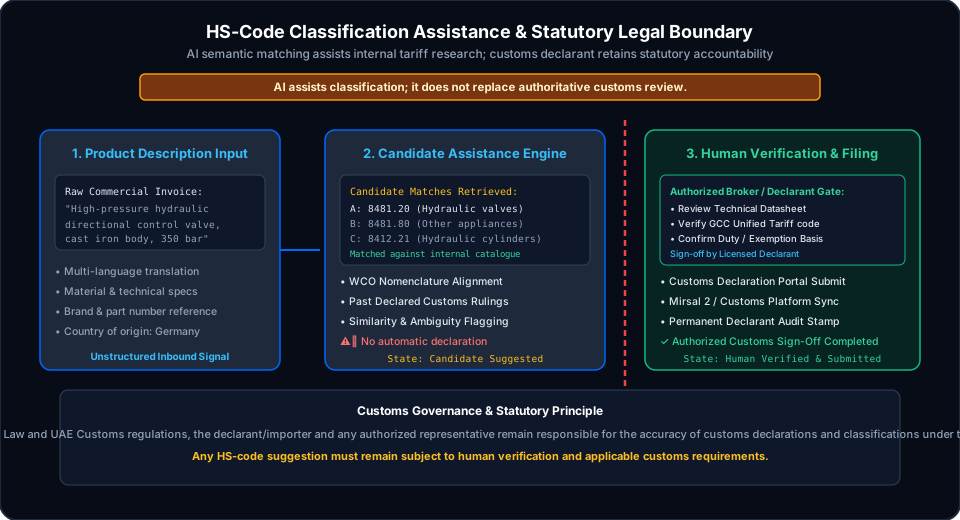
AI and document extraction technologies can assist operations teams by extracting product descriptions, retrieving candidate classifications from approved internal product catalogues, and flagging ambiguous terminology. However, systems must never be presented as legally authoritative for customs declarations, automatic tariff determination, or statutory compliance. Any HS-code suggestion must remain subject to human verification and applicable customs requirements. Under the GCC Common Customs Law and UAE customs regulations, The declarant/importer and any authorized representative remain responsible for the accuracy of customs declarations and classifications under the applicable customs framework.
Automated pipelines support the human customs specialist through three structured assistance capabilities:
- Internal Product Master Mapping: If an extracted product description or manufacturer SKU matches an approved entry in the company's historical ERP database, the system presents the verified, previously declared HS code alongside past declaration references.
- Candidate Suggestion & Ambiguity Flagging: When new or unmapped products arrive, the system uses semantic search to present candidate 6-digit or 8-digit tariff headings from the official customs tariff schedule, highlighting where technical datasheets or composition breakdowns are required.
- Mandatory Human Sign-Off Gate: The pipeline enforces an immutable workflow block: no customs declaration payload can be compiled or transmitted without explicit sign-off by a qualified internal customs officer or licensed brokerage agent.
7. The Deterministic Validation Layer
Before any extracted document payload reaches an operational exception queue or downstream business software, it passes through an automated validation layer. These checks represent operational validation rules designed to ensure data hygiene, not legal compliance certification.
| Validation Rule | Logical Evaluation | Pass / Fail Consequence |
|---|---|---|
| Mathematical Total Reconciliation | Sum(Line Items) + Freight + Insurance = Total Value |
Variance exceeding rounding tolerance routes ticket directly to exception queue. |
| Mandatory Header Fields Present | Verifies presence of Invoice #, Invoice Date, Supplier, Buyer, Currency. | Missing mandatory values trigger OCR re-scan or manual data entry routing. |
| Currency Code Verification | Validates currency string against ISO 4217 standard currency list. | Unrecognized currency notation flags document for operator clarification. |
| Duplicate Invoice Check | Checks [Supplier_ID + Invoice_Number] against ERP database. |
Duplicate match triggers version-control logic or flags duplicate submission. |
| Date Plausibility Check | Ensures invoice date is valid calendar date not set in future or exceeding age caps. | Out-of-range dates route for operator review to prevent accounting period errors. |
8. Confidence Scoring & Review Routing
Every extracted field is accompanied by an OCR confidence score (ranging from 0.00 to 1.00) calculated by the recognition engine based on character clarity, visual contrast, and dictionary alignment. The automation engine aggregates these individual metrics into a composite document confidence rating.

Illustrative configurable thresholds — organization-specific. Operational triage thresholds must be calibrated to each enterprise's risk tolerance, document variety, and quality policies.
An illustrative three-tier operational routing model operates as follows:
- Tier 1: High Confidence (e.g., Composite Score ≥ 0.90): All mandatory fields extracted with high optical fidelity; mathematical reconciliation produces zero variance; supplier and buyer match existing master records. Action: Structured record compiled and staged for standard operator review or automated draft creation.
- Tier 2: Medium Confidence / Ambiguous (e.g., 0.70 ≤ Composite Score < 0.90): Header fields clear, but one or more line-item descriptions contain low-confidence characters, minor formatting variations, or an unrecognized Incoterm. Action: Record routed to the operator confirmation queue with questionable fields highlighted in the user interface.
- Tier 3: Low Confidence / Rejection (e.g., Composite Score < 0.70): Illegible scan, significant physical skew, overlapping stamps obscuring figures, or failure of mathematical reconciliation checks. Action: Record routed to the manual extraction exception queue for full human data entry.
9. Downstream ERP, TMS & Finance Handoff
Once a document has successfully cleared automated validation or received human approval, the data payload must be transmitted to downstream enterprise systems—such as SAP, Oracle NetSuite, Microsoft Dynamics 365, CargoWise, or custom proprietary warehouse software.
Connecting document automation to operational software requires robust integration architecture, subject to API availability, account permissions and provider capabilities:
- Canonical JSON Schema Dispatch: Extracted records are transformed into destination-specific API payloads (e.g., draft vendor bills, purchase order receipts, or shipment declarations) via structured REST or GraphQL endpoints.
- Durable Message Queues & Retry Backoff: API requests are dispatched through message brokers (such as Redis Streams, RabbitMQ, or AWS SQS). If the ERP system undergoes maintenance or encounters temporary rate limits, transactions are buffered and retried with exponential backoff and jitter.
- Idempotency Keys: Every downstream transmission payload carries a deterministic idempotency key (e.g.,
IDEMP_GIT09842_20260909). This prevents duplicate invoice records or double-booked goods receipts if network timeouts interrupt acknowledgment responses. - Asynchronous Status Reconciliation: Once the ERP confirms successful record creation, the system writes the external transaction ID (e.g., ERP Bill #48201) back to the document archive, closing the ingestion loop.
10. Duplicate Detection & Document Version-Control Handling
In high-volume supply chain operations, duplicate document submissions represent a frequent source of data pollution and financial risk. Overseas vendors may email an invoice, re-send an amended version two days later with revised freight charges, or attach the same document across multiple correspondence threads.
A resilient pipeline implements a layered version-control model:
- Cryptographic Binary Deduplication: When a file arrives, its SHA-256 hash is checked against the database. If an identical file has already been ingested, the submission is flagged as an exact duplicate and discarded from re-processing, referencing the existing ticket.
- Business Key Correlation: If a document has a different file hash (e.g., a re-scanned page) but shares the identical
[Supplier_ID + Invoice_Number], the system flags it as an amended submission. - Versioned Revision Branching: When an amended invoice arrives, the automation layer does not silently overwrite the previous record. Instead, it creates a revision record (e.g.,
INV-001-REV-2), marks the original as superseded, and prompts an operations reviewer to confirm whether changes reflect legitimate commercial amendments.
11. The Human-in-the-Loop Exception Queue
The goal of document automation is not to eliminate human oversight, but to eliminate redundant manual typing while directing human cognitive attention where it is genuinely needed.
An effective exception interface provides operations clerks with a unified verification workspace:
- Side-by-Side Visual Verification: The original document PDF/image is displayed on the left side of the screen, with extracted editable fields on the right. Clicking any extracted field immediately navigates and zooms the document viewer to the exact bounding box where the character was detected.
- Visual Confidence Highlighting: High-confidence fields appear with subtle neutral styling, while low-confidence or mathematically unverified figures display distinct warning banners.
- Single-Click Master Data Linking: If an extracted vendor name or shipping line is unmapped, the operator can link it to an existing ERP master record with a single selection, simultaneously training the system's alias lookup table for future shipments.
12. Append-Only / Tamper-Evident Audit Trail & Data Lineage
Commercial operations within regulated free zones must be prepared for retrospective tax audits, customs reviews, and internal corporate compliance inspections. The automation architecture maintains complete data lineage across every processed transaction:
- Original Binary Preservation: The original, unmodified source document (PDF, TIFF, JPEG) is archived in write-once-read-many (WORM) storage architecture.
- Step-by-Step State Logging: Every state change is recorded with a tamper-evident timestamp, including ingestion time, OCR execution parameters, initial extracted values, confidence scores, and rule evaluation outcomes.
- User Edit Tracking: If an operator modifies an extracted value in the exception queue, the audit log records the user ID, original extracted string, edited string, reason for modification, and timestamp.
- Downstream Transmission Receipts: Exact API payloads, server response headers, and ERP confirmation codes are logged, establishing an unbroken forensic chain from email arrival to general ledger posting.
13. UAE Data-Protection & Governance Considerations
Commercial documentation involves proprietary trade data, supplier pricing schedules, customer identities, and personnel contact details. Deploying automation requires careful alignment with local regulatory and enterprise security standards.
The architecture should be designed to support the organization's applicable UAE data-protection, retention and access-control requirements, subject to internal legal and governance review. In particular, organizations handling customer personal data must establish clear operational controls consistent with UAE Federal Decree-Law No. 45 of 2021 regarding Personal Data Protection (PDPL).
Key technical governance controls include:
- Regional Cloud Infrastructure & Data Residency: Organizations with sensitive trade profiles or institutional governance mandates should deploy OCR inference containers, database clusters, and message brokers within dedicated UAE cloud regions.
- Cryptographic Security at Rest & Transit: All file transfers must travel via TLS 1.3 encrypted channels. Stored documents and database volumes must be protected using AES-256 encryption.
- Granular Role-Based Access Controls (RBAC): Access to sensitive commercial invoices and pricing data must be restricted to authorized finance and operations personnel. Warehouse receiving staff access only packing list metrics (weights, quantities, container numbers) without visibility into commercial unit values.
- Configurable Data Retention Schedules: Document retention policies must define explicit lifecycle rules, automatically moving historical documents to cold archive tiers or purging temporary extraction buffers in accordance with statutory retention requirements.
14. Production Failure Modes & Engineering Mitigations
Enterprise document systems must be architected defensively to handle real-world operational challenges without losing data or halting warehouse workflows:
| Failure Scenario | Operational Root Cause | Architectural Mitigation |
|---|---|---|
| Corrupted or Unreadable Scans | Low mobile photo resolution, extreme skew, missing pages. | Automated pre-flight image quality check; immediate automated notification to sender requesting clean digital document. |
| Supplier Template Layout Shifts | Overseas supplier updates invoice software or alters table styling. | Semantic key-value extraction models combined with fallback heuristic anchors; alerts raised when extraction confidence degrades. |
| Downstream ERP API Outage | ERP scheduled maintenance, network timeout, or rate-limiting. | Durable message queues (SQS/Redis) buffer validated payloads; exponential backoff retries dispatch upon ERP service resumption. |
| Unmapped Vendor Master Record | First-time overseas supplier not yet created in ERP system. | Routed to Master Data exception queue; clerk maps or creates vendor profile, automatically resuming document pipeline. |
| Human Review Backlog | Surge in seasonal shipping volumes exceeding clerk review capacity. | Automated workload balancing, priority queuing based on vessel arrival schedules, and SLA breach alert thresholds. |
15. The Build vs. Buy Decision Framework
Organizations evaluating document automation must determine whether to license an off-the-shelf document processing product, construct an event-driven automation layer, or develop a bespoke software platform.
Scenario A: Standard Packaged Document Software
When to Use: The organization processes standard commercial documents with consistent layouts; document volume is modest; standard out-of-the-box connectors cover existing accounting software; and internal engineering resources are limited.
Trade-Off: Fast deployment with predictable subscription costs; however, customization is restricted, and specialized bilingual or multi-system routing rules may require expensive vendor enhancements.
Scenario B: Custom Automation Layer (Best Practice for Scaling Operators)
When to Use: Documents arrive across multiple unstructured channels (email, SFTP, portals); business validation rules require cross-system reconciliation (invoices against packing lists and POs); bilingual Arabic/English handling is vital; and existing ERP/TMS software requires customized API mapping.
Trade-Off: Combines proven OCR/LLM extraction models with tailor-made workflow orchestration, providing full data ownership, custom exception workflows, and adaptable business logic without rebuilding core ERP software.
Scenario C: Bespoke Proprietary Software Build
When to Use: The organization is a specialized logistics technology provider where document processing represents the core commercial software product; or proprietary regulatory constraints prevent the use of third-party extraction microservices.
Trade-Off: Complete architectural control; however, incurs high initial capital expenditure, continuous computer vision model maintenance, and substantial technical debt. Building equivalent systems internally can introduce substantial engineering, governance, and maintenance responsibility compared with leveraging established frameworks.
16. Phased Implementation Roadmap
Deploying automated document processing into an active supply chain requires deliberate, phased execution to ensure business continuity without disrupting daily cargo clearances:
Phase 1: Document Sample Collection & Field Taxonomy (Weeks 1–3)
Assemble a representative corpus of historical commercial invoices, packing lists, and manifests across primary trading corridors. Define the canonical field schema and document mandatory validation rules.
Phase 2: Extraction Pipeline & Validation Engine Setup (Weeks 4–7)
Configure OCR ingestion, train custom entity extraction models on representative trade documents, and establish mathematical reconciliation rules.
Phase 3: Human-in-the-Loop Exception Workspace Deployment (Weeks 8–10)
Deploy the side-by-side verification interface for documentation clerks. Establish confidence routing policies and train staff on exception handling.
Phase 4: ERP/TMS Integration & Pilot Parallel Run (Weeks 11–14)
Connect API dispatch endpoints to the staging ERP environment. Run the automated pipeline in parallel with manual processing to measure reconciliation fidelity before transitioning to live production handoffs.
17. 10-Point Technical Readiness Checklist for Operations Leadership
Document Sources Mapped: Document all channels where shipping paperwork enters the organization (supplier emails, portals, shared drives, freight agents).
Representative Sample Corpus Collected: Assemble a representative test set of historical invoices, packing lists, and bills of lading reflecting standard trade corridors.
Canonical Target Fields Defined: Document required header and line-item entities, standardizing date formats, currencies, and unit codes.
Authoritative System of Record Identified: Confirm the primary destination database (ERP, TMS, or WMS) for financial and physical inventory data.
Downstream API Permissions Verified: Verify that target software environments provide programmatic REST/GraphQL endpoints with appropriate read/write credentials.
Deterministic Validation Rules Configured: Establish mathematical reconciliation constraints and mandatory field criteria for automated checks.
Human Review Responsibility Assigned: Designate trained documentation clerks and customs officers to manage the exception review queue.
Governance & Retention Standards Documented: Establish data residency, encryption, and document retention policies consistent with enterprise governance policies.
Monitoring & DLQ Queues Designed: Configure durable message queuing and alerting to buffer payloads during downstream software maintenance.
Customs Classification Boundaries Documented: Formalize the operational rule that all automated HS-code suggestions remain subject to human verification and applicable customs requirements.
18. Frequently Asked Questions
Can an AI system automatically file customs declarations without human review?
No. Under the GCC Common Customs Law and UAE customs regulations, the importer of record or their licensed customs broker bears legal responsibility for all declarations. AI systems accelerate data extraction and suggest candidate classifications, but formal submission must remain subject to human verification and applicable customs requirements.
How does the system handle poor-quality mobile photos or scanned invoices?
Incoming files pass through image conditioning microservices that adjust contrast, correct skew, and remove noise. However, OCR performance varies by scan quality and layout. Documents failing minimum visual clarity thresholds or mathematical checks automatically route to the human exception queue for manual verification.
Which ERP and TMS platforms can be integrated?
The architecture is system-agnostic and connects via standard REST APIs, webhooks, or secure database connectors to platforms such as SAP, Oracle NetSuite, Microsoft Dynamics 365, CargoWise, and custom proprietary systems, subject to API availability, account permissions and provider capabilities.
19. Technical References & Standards
- • World Customs Organization: HS Nomenclature (2022 Edition & Updates)
- • UAE Legislation Portal: Federal Decree-Law No. 45 of 2021 on Personal Data Protection (PDPL)
- • Dubai Customs: Customs Policies, Mirsal 2 Architecture & Client Accreditation Procedures
- • International Chamber of Commerce: ICC Incoterms 2020 Rules & Commercial Terms
- • ISO: ISO 6346: Freight Containers — Coding, Identification and Marking
Automate Your Free-Zone Documentation Pipeline
Eliminating manual data re-entry while maintaining stringent audit trails and customs compliance is essential for high-volume trading and logistics operations in the UAE.
To review your operational documentation workflows or explore tailored enterprise integrations, explore Asif Digital's specialized workflow automation for UAE operations teams and AI automation architecture for Dubai businesses.