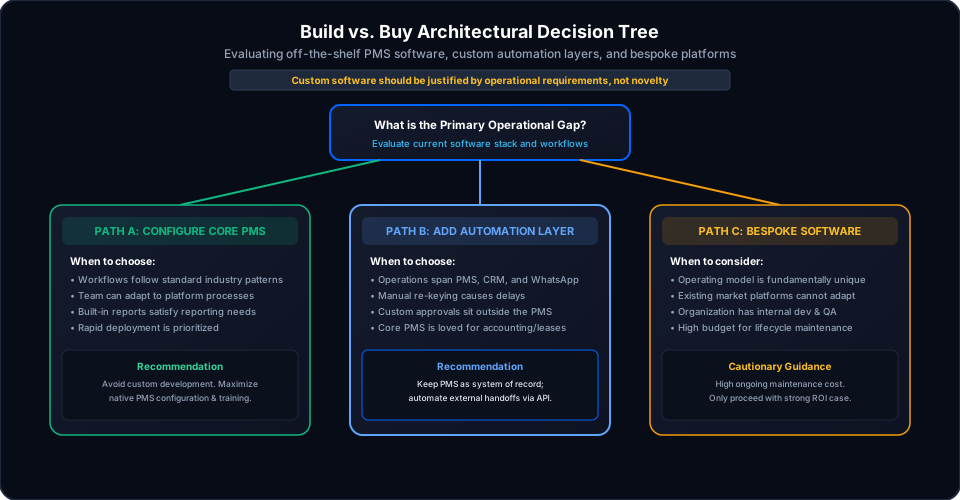
Executive Summary: Software vs. Workflow Architecture
Property management operations across Dubai face an architectural crossroads. As portfolios scale across residential towers, villa communities, and commercial assets, leadership teams frequently debate whether to replace existing Property Management Software (PMS) with custom software or adopt an external automation layer. In practice, treating this as a binary choice—"off-the-shelf PMS vs. custom software"—misdiagnoses the operational challenge. A mature property management software serves as an indispensable system of record for lease ledgers, legal unit registries, and financial transactions. Friction arises when rigid core software is forced to handle dynamic, multi-channel operational workflows: omnichannel tenant messaging, conversational maintenance triage, vendor dispatch, and automated renewal coordination. The modern engineering paradigm preserves the PMS as the authoritative transactional core while deploying an event-driven automation layer around it to orchestrate tenant engagement, unstructured triage, and cross-system data synchronization.
1. The Real Decision: Software vs. Workflow Architecture
In property management operations across Dubai, executive discussions around digital modernization often stall on a false dichotomy: should the firm continue licensing an established enterprise Property Management System (PMS)—such as MRI Software, Yardi Systems, RealCube, or custom ERP modules—or commit capital to building bespoke property management software from scratch?
Enterprise technology audits across UAE real estate operators indicate that this framing misidentifies where business value and operational friction actually reside. A core PMS is designed to be a system of record. It provides structured schema definitions for properties, units, tenant entities, lease agreements, post-dated cheques (PDCs), payment schedules, and general ledger accounts. Building equivalent systems internally can introduce substantial engineering, governance and maintenance responsibility compared with retaining a proven system of record.
The operational bottlenecks that degrade tenant satisfaction and inflate headcount are rarely found in the accounting ledger. Instead, they occur in the systems of engagement and workflow orchestration: handling unstructured tenant voice notes and photos on WhatsApp, triaging emergency air conditioning failures during summer peaks, coordinating subcontractor quotes, dispatching technicians, verifying job completion, and sending timely renewal notices. When organizations attempt to force rigid back-office software to handle dynamic front-line human workflows, operational bottlenecks inevitably multiply.
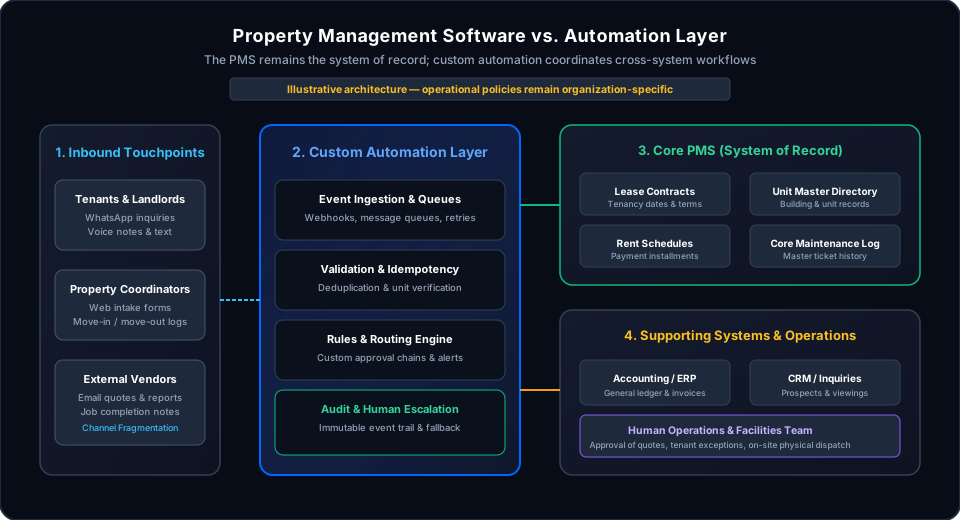
The strategic objective is not to discard the PMS, but to decouple data retention from process execution. By implementing an intelligent, event-driven automation layer around the core database, property operators retain accounting rigor and auditability while achieving flexible, conversational tenant workflows.
2. Where Off-the-Shelf PMS Excels: The Indispensable System of Record
Established commercial property management software platforms have evolved over decades to handle intricate property accounting standards and legal tracking requirements. Attempting to replace these foundational functions with ad-hoc internal custom code introduces serious systemic vulnerabilities. Standard commercial PMS solutions remain unmatched in several core areas:
- Double-Entry Lease Accounting & Ledger Integrity: Core property management software maintains strict double-entry accounting ledgers. It tracks security deposits, deferred revenue amortizations, service charge reconciliations, value-added tax (VAT) schedules, and payment receipts with comprehensive audit histories required by institutional investors and external auditors.
- Master Unit & Tenancy Registries: The PMS maintains the authoritative database hierarchy: legal entity → property portfolio → building → unit → tenant profile → lease contract → payment milestone. This structured relational model prevents orphaned contracts or mismatched asset allocations.
- Regulatory & Tenancy Baseline Tracking: Standard platforms provide out-of-the-box fields for Dubai Land Department (DLD) metadata, Ejari contract registration records, title deed numbers, and premises identifiers. They serve as a structured repository for statutory documentation.
- Standardized Historical Reporting: Generating institutional rent rolls, vacancy duration reports, aging receivables schedules, and building-level profit and loss (P&L) statements requires centralized historical financial records that commercial platforms are purpose-built to deliver.
When an organization evaluates modernization, preserving the integrity of this transactional core is paramount. Any architecture that bypasses or corrupts the master financial ledger creates immediate compliance and reconciliation risks.
3. Where Standard Software Starts to Create Operational Friction
If commercial PMS platforms excel as databases of record, why do Dubai operations teams experience persistent operational frustration? Friction emerges because standard enterprise software was engineered for desktop-bound administrators, not for mobile tenants, building security teams, or external maintenance contractors.
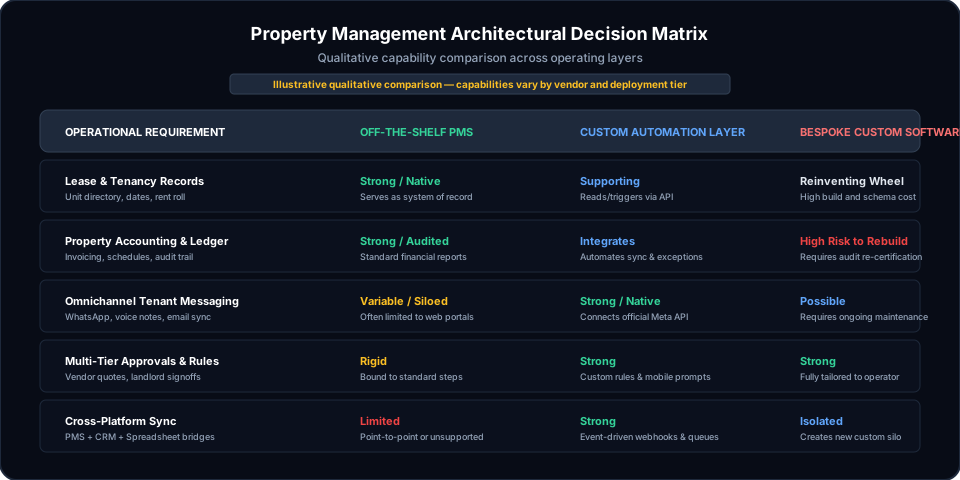
Typical failure points in standard software workflows include:
- Channel Fragmentation & External Messaging: Standard PMS packages provide tenant web portals or downloadable mobile applications. In practice, tenant communication may occur outside the PMS, creating disconnected operational records. When inquiries, photo attachments, or maintenance requests are sent directly to building staff or property coordinators via external channels, updates often fail to synchronize with the core database.
- Unstructured Maintenance Intake: Standard ticketing modules require users to categorize issues using rigid taxonomy trees (e.g., MEP → Plumbing → Fixtures → Cartridge Leak). Tenants routinely select arbitrary categories or type generic descriptions like "broken water". Administrative personnel must manually review each ticket, contact the tenant for clarifications, request photos, and reclassify the issue before assigning a contractor.
- Fragmented Contractor Handoffs: While the PMS may record that a work order was issued, communication with third-party facilities management (FM) contractors usually collapses into unmonitored external phone calls, private WhatsApp messages, and email threads. Status updates in the PMS lag behind real-world physical repairs.
- Rigid, Impersonal Communications: Standard system notifications consist of generic transactional emails or SMS alerts that tenants ignore. They lack conversational awareness, multi-lingual flexibility (such as natural Arabic dialect comprehension or Russian language support), and contextual history.
- Costly Customization Cycles: Requesting custom workflow changes, specialized approval routing, or non-standard dashboard views from enterprise PMS vendors frequently involves multi-month professional service engagements and recurring license surcharges.
4. Custom Automation Architecture: The Event-Driven Coordination Layer
To eliminate front-line friction without destabilizing the back-office ledger, leading Dubai property operators deploy an asynchronous, event-driven automation layer. Rather than replacing the PMS, this coordination engine connects external communication channels, conversational intelligence services, and facility vendor systems with the central database via authenticated APIs.
The core architectural components of this layer include:
- Multi-Channel Ingestion Gateway: Inbound webhooks capture events from official messaging channels (such as the Meta WhatsApp Cloud API), email inboxes, web forms, and IoT sensor alerts. Every incoming request is assigned a unique idempotency key to prevent duplicate processing.
- Durable Message Broker & Queue: Incoming payloads are immediately acknowledged and placed on a durable message queue (such as Redis Streams, RabbitMQ, or Amazon SQS). This decouples event reception from processing logic, ensuring zero dropped messages during traffic surges.
- Cognitive Triage & Extraction Engine: Specialized language processing models parse unstructured natural text, voice notes, and photographic attachments. The engine extracts the tenant identity, unit reference, issue classification, severity tier, and sentiment, formatting the output into a standardized JSON payload.
- Configurable Rules Engine: Business logic evaluates the structured ticket against property-specific Service Level Agreements (SLAs), warranty statuses, contractor contracts, and human escalation policies.
- Two-Way Synchronization Adapters: Verified updates are written programmatically to the PMS API to update tenant logs or create work orders, while conversational progress updates are dispatched back to the tenant over their preferred messaging channel.
- Dead-Letter Queue (DLQ) & Exception Handling: If the downstream PMS API undergoes scheduled maintenance or returns rate-limit errors, the transaction is buffered and retried with exponential backoff. If failures persist beyond configured retry limits, the event is routed to an operational DLQ for human investigation.
5. Tenant Communication Automation: Dedicated Portals vs. Conversational WhatsApp
Managing tenant communications across disparate channels presents significant operational challenges. While proprietary property management portals provide structured forms, tenant communication may occur outside the PMS, creating disconnected operational records. WhatsApp can be integrated as an additional communication channel where appropriate and permitted, enabling organizations to capture inquiries, photos, and status requests within a unified audit trail.
| Dimension | Proprietary PMS Tenant App | Official WhatsApp Automation Layer |
|---|---|---|
| Access & Authentication | Requires portal login credentials, password resets, or app installations | Accessible directly via verified phone numbers on active messaging channels |
| Channel Workflow Integration | Restricted to interactions initiated within the proprietary software interface | Orchestrates multi-channel messaging while synchronizing records to the PMS |
| Media Ingestion Fidelity | Restricted file upload dialogs; poor mobile video support | Native support for mobile photos, videos, and conversational voice notes |
| Linguistic Adaptability | Static localized UI labels; rigid predefined templates | Dynamic multi-lingual comprehension (Arabic dialects, English, Russian, French) |
| Data Synchronization | Native internal database records | Event-driven two-way sync via official Meta Cloud API & PMS webhooks |
By leveraging official Meta WhatsApp Cloud API infrastructure, property management operators can automate routine inquiries—such as Move-In permit checklists, Move-Out inspection scheduling, amenity bookings, visitor parking passes, and payment receipt verifications—without human agent intervention, while logging every conversation thread directly to the tenant's CRM profile.
6. Maintenance Intake & Human-in-the-Loop Vendor Coordination
Maintenance intake represents the single largest operational cost center and source of tenant dissatisfaction in residential property management. During peak summer months in Dubai, air conditioning (chiller/split AC) failures and plumbing bursts require rapid diagnostic intake and vendor dispatch.
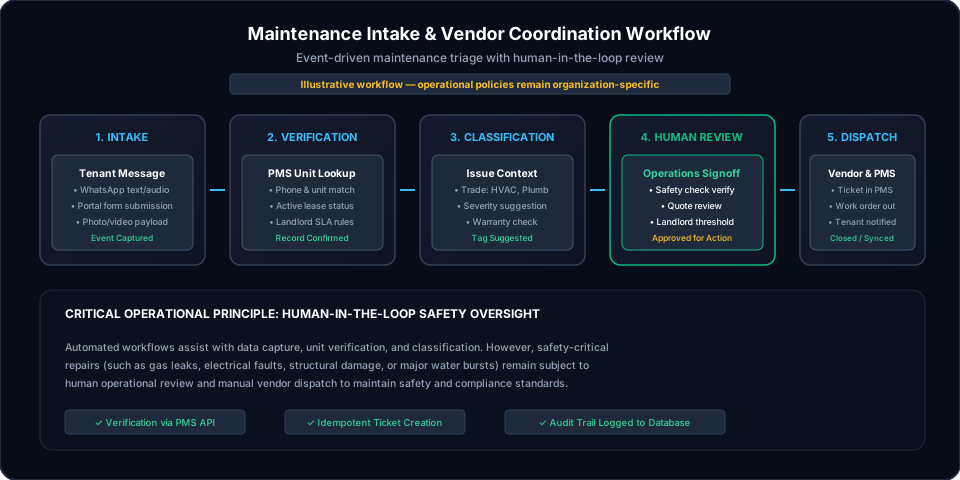
Structured Data Extraction from Unstructured Inquiries
When a resident sends a voice note stating: "Hi, my AC in the master bedroom is blowing warm air and making a loud rattling sound, and water is starting to drip on the parquet floor," an automated triage microservice parses the message, transcribes audio if necessary, and extracts a normalized JSON schema:
{
  "ticket_id": "MNT-2026-09842",
  "idempotency_key": "ac_leak_unit_1402_20260909_0841",
  "timestamp_utc": "2026-09-09T04:41:12Z",
  "tenant": {
    "tenant_id": "TNT-88412",
    "phone_e164": "+971501234567",
    "unit_reference": "Tower B - Unit 1402",
    "property_name": "Dubai Marina Horizon"
  },
  "extracted_issue": {
    "trade_category": "HVAC",
    "sub_system": "Fan Coil Unit (FCU)",
    "primary_symptoms": ["Warm air discharge", "Mechanical rattling", "Condensate water leakage"],
    "location_in_unit": "Master Bedroom",
    "property_damage_risk": "High (Parquet flooring exposure)"
  },
  "suggested_triage": {
    "severity_tier": "P1_URGENT",
    "safety_critical": true,
    "suggested_vendor": "CoolTech FM Services LLC",
    "contract_status": "Under Active AMC",
    "sla_target_response_hours": 2
  },
  "governance": {
    "human_review_required": true,
    "review_reason": "Active water leakage posing structural interior risk",
    "status": "Awaiting_Operations_Approval"
  }
}For suspected emergencies or immediate threats to life or property, users should follow the organization's emergency procedure or contact the appropriate emergency authority rather than relying on automated classification.
Artificial intelligence models can assist with routine categorization, diagnostic logging, and draft documentation. However, all safety-critical maintenance events—including gas leaks, electrical faults, structural damage, and major water pipe ruptures—must remain subject to human operational review and explicit authorization before dispatching external contractors or authorizing emergency capital expenditures. Automated systems accelerate intake and documentation; human operators and emergency protocols retain ultimate authority.
Artificial intelligence models can reliably categorize symptoms, suggest trade codes, and draft work orders. However, all safety-critical maintenance events—including gas leaks, electrical faults, structural damage, and major water pipe ruptures—must be subject to human operational review and explicit authorization before dispatching external contractors or authorizing emergency capital expenditures. Automated systems accelerate triage; human operators retain accountability.