
Executive Summary: Attribution Signal Loss in Paid Advertising
In Dubai's high-competition digital ad market, customer acquisition costs across Google Ads and Meta Ads are heavily influenced by algorithmic bidding efficiency. Yet marketing teams frequently observe that reported ad conversions fail to match downstream sales pipeline reality. Client-side browser restrictions (Safari ITP, mobile webviews, ad blockers) cause significant attribution signal loss. When ad platforms only receive raw, unverified client-side lead form events, bidding algorithms optimize for cheap, low-intent inquiries. Implementing server-side Meta Conversions API (CAPI), Google Enhanced Conversions for Leads, and automated CRM offline milestone imports restores full-funnel attribution and trains bidding models on verified revenue outcomes.
Marketing teams managing paid customer acquisition in Dubai operate across one of the most competitive ad environments globally. Across off-plan property investment, wealth management, private healthcare, and enterprise B2B services, acquiring targeted customer attention requires substantial capital expenditure.
Yet a structural measurement breakdown compromises many campaigns: post-lead attribution signal loss. Digital marketing dashboards frequently report impressive conversion figures inside Meta Ads Manager or Google Ads, while sales directors report that brokers or sales development representatives are handling unverified inquiries, incorrect contact details, and unengaged prospects.
This disconnect is rarely caused by ad creative alone; it is fundamentally an architectural tracking failure. When ad platforms lack visibility into which inquiries convert into qualified commercial conversations, machine learning bidding algorithms (such as Google Smart Bidding and Meta Advantage+) optimize primarily for low-friction form submitters. Below is an engineering guide to diagnosing signal degradation, deploying server-to-server tracking, and connecting CRM milestone data with ad delivery algorithms.
1. Root Causes of Attribution Degradation in the UAE Ecosystem
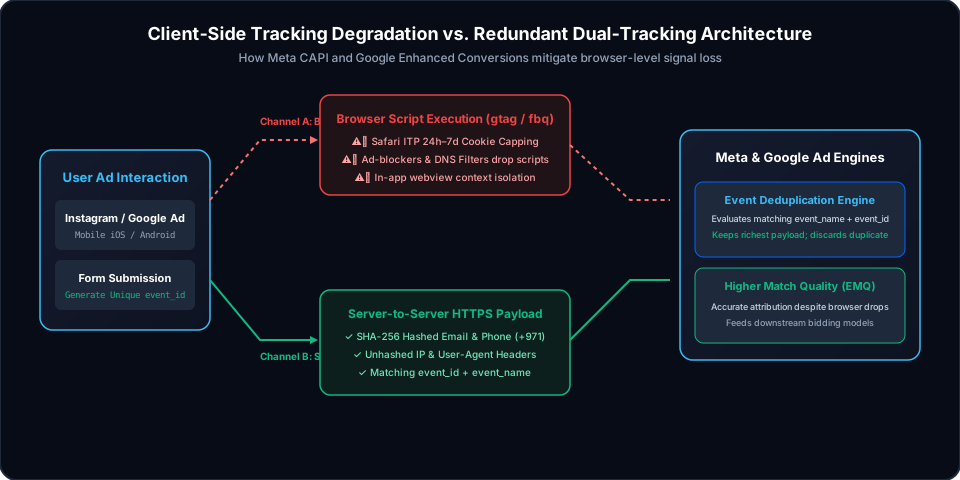
Multiple technical factors compound to degrade client-side browser tracking in the UAE market:
- Intelligent Tracking Prevention (ITP) & Storage Caps: Apple's WebKit ITP imposes strict 24-hour to 7-day caps on client-side script-writable cookies. In a mobile-heavy market where iOS market share is exceptionally high, browser-set cookie identifiers frequently expire before high-value property or B2B buyers complete their multi-week evaluation cycles.
- In-App Browsers & Social Webviews: Prospects engaging with ads on Instagram, LinkedIn, or TikTok view landing pages inside sandboxed in-app browsers. If the user later switches to Safari, Chrome, or WhatsApp to continue their research, the client-side session is fractured and cookie continuity is severed.
- Ad-Blockers & Private DNS Filtering: Privacy-conscious executives and high-net-worth investors frequently browse using content blockers and private DNS profiles that drop third-party analytics scripts (including standard
gtag.jsand Meta Pixel) before they can execute. - Cross-Device Conversion Paths: An investor typically discovers a real estate development on a smartphone while commuting, evaluates payment plans on a desktop computer, and ultimately initiates contact via WhatsApp or a direct telephone call. Client-side cookies cannot connect this journey without persistent first-party identifiers.
2. Meta Conversions API (CAPI) & Deduplication Mechanics
To overcome client-side vulnerabilities, organizations deploy the Meta Conversions API (CAPI) to establish direct, server-to-server event communication between backend infrastructure and Meta's measurement servers.
Dual Redundant Tracking & Event Deduplication
A resilient tracking architecture does not eliminate the client-side pixel. Instead, it utilizes dual tracking: the browser pixel fires client-side while the backend server transmits an identical event payload over a secure HTTPS endpoint.
To prevent double-counting conversions in reporting and algorithmic optimization, Meta requires matching deduplication parameters across both event channels:
event_name: Must match exactly across both events (e.g.,Lead).event_id: A unique identifier (such as a UUID v4) generated on the server and shared between the client-side pixel event and the server-side CAPI payload.
// Client-side execution at form submission
const leadEventId = "evt_d7b89f21-4c12-48a6-9f30-812049e7b2a1";

fbq('track', 'Lead', {
  content_name: 'Dubai Hills Villa Inquiry',
  currency: 'AED',
  value: 0.00
}, { eventID: leadEventId });{
"data": [
{
"event_name": "Lead",
"event_time": 1788862462,
"event_id": "evt_d7b89f21-4c12-48a6-9f30-812049e7b2a1",
"event_source_url": "https://www.asifdigital.agency/real-estate",
"action_source": "website",
"user_data": {
"em": ["f660ab912ec121d1b1e928a0bb4bc61b15f5ad44d5efdc4e1c92a25e99b8e44a"],
"ph": ["4c18f77626915b88cb75d1d6248b3b44fd3e0ffef29b8c0c800b468579040332"],
"client_ip_address": "86.96.12.140",
"client_user_agent": "Mozilla/5.0 (iPhone; CPU iPhone OS 18_2 like Mac OS X)...",
"fbp": "fb.1.1788862400.104928172",
"fbc": "fb.1.1788862400.IwAR1XyZ..."
}
}
]
}When Meta's servers receive both events, the deduplication engine inspects the matching event_name and event_id, consolidates the browser and server payloads, retains the most complete parameter set, and discards the duplicate. This preserves campaign attribution even when browser scripts are interrupted.
3. Parameter Normalization & Hashing Sequence
To protect consumer privacy and ensure high Event Match Quality (EMQ), customer data must undergo a rigorous sequence: normalization → hashing → transmission.
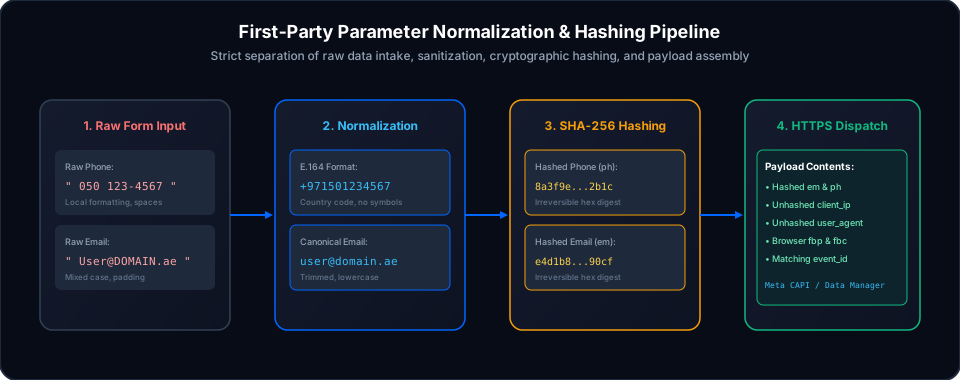
- Telephone Normalization: Raw numbers must be stripped of all non-numeric characters (parentheses, hyphens, spaces), leading zeros removed, and formatted in international E.164 standard (e.g., UAE local mobile
050 123 4567becomes+971501234567). - Email Normalization: Raw email strings must be whitespace-trimmed and converted entirely to lowercase (e.g.,
Investor@Domain.AEbecomesinvestor@domain.ae). - Cryptographic Hashing: Normalized values are hashed using the SHA-256 algorithm, outputting an irreversible 64-character hexadecimal digest.
- Unhashed Technical Parameters: Technical network headers—including
client_ip_address,client_user_agent, and first-party browser cookies (fbp,fbc)—are transmitted unhashed per platform documentation.
4. Google Ads Data Manager & Offline Conversion Imports
For Google Search, Performance Max, and YouTube campaigns, measuring lead quality requires integrating first-party form data with downstream conversion milestones.
Under Google's current architecture (including the transition toward Google Ads Data Manager and supported connector workflows), offline lead conversion data can be synchronized programmatically:
- Lead Capture: When a user submits an inquiry form, the website captures the Google Click Identifier (
gclid) or cross-channel web identifiers (wbraid,gbraid), alongside hashed first-party customer parameters (email and telephone). - CRM Storage: Identifiers are stored securely in the agency CRM alongside the contact record and deal creation timestamp.
- Milestone Uploads: When the lead subsequently achieves a sales-qualified milestone offline (such as an in-person viewing or signed reservation), conversion adjustments are transmitted through Google Ads Data Manager / supported API or connector workflows, depending on the current account configuration.
Import availability and lookback behavior vary by data source and current Google Ads configuration; verify the active Data Manager specification before implementation. Ensuring scheduled daily synchronization keeps bidding algorithms updated with fresh conversion signals.
5. The Downstream CRM Milestone Feedback Loop
The strategic purpose of server-side attribution is not merely retrospective reporting; it is training advertising algorithms to bid on actual business value.
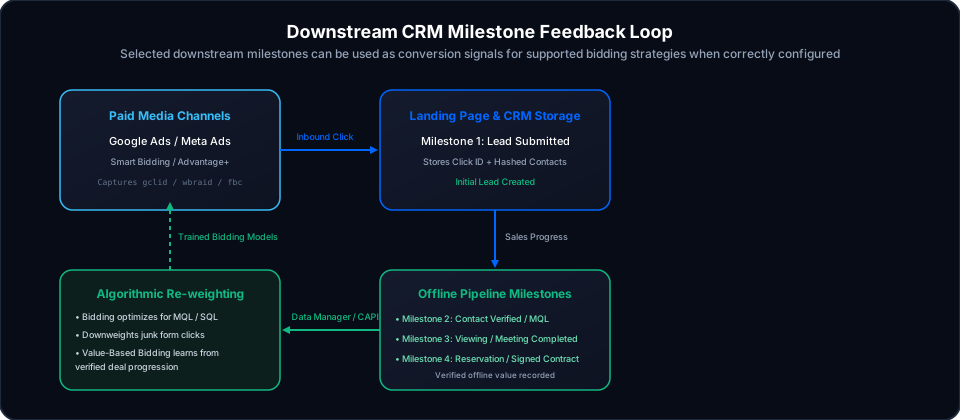
When an agency optimizes paid campaigns exclusively for Milestone 1 (initial form submission), ad platform algorithms optimize for the cheapest available form completions. By contrast, selected downstream milestones can be used as conversion signals for supported bidding strategies when correctly configured:
| Pipeline Milestone | Operational Meaning | Bidding Optimization Role |
|---|---|---|
| Milestone 1: Form Submitted | Raw inquiry received; unverified contact details | High-volume volume signal; risk of algorithmic drift toward low-intent clickers. |
| Milestone 2: Requirement Verified (MQL) | Active WhatsApp dialogue; confirmed budget & purchase timeline | Secondary optimization signal; filters out wrong numbers and disengaged users. |
| Milestone 3: Viewing / Consultation (SQL) | Completed in-person or video property walkthrough | Primary Target CPA conversion signal; steers algorithmic bids toward genuine buyers. |
| Milestone 4: Reservation / Contract (Won) | Booking fee received; Oqood / SPA signed | Value-Based Bidding (tROAS) signal; trains models on high-margin transactions. |
6. Common Implementation Failure Modes
Server-side attribution architectures fail when technical guardrails are omitted:
- Mismatched Deduplication Keys: Generating separate
event_idvalues on the client and server causes ad platforms to record double conversions, falsely inflating conversion counts and confusing automated bidding. - Raw Payload Transmission: Transmitting unhashed email addresses or telephone numbers violates platform terms of service and triggers API rejection errors.
- Missing Click Identifiers on Mobile Hand-offs: If web forms fail to store
gclidorfbclidin hidden fields before a user switches to WhatsApp, offline conversion uploads cannot be paired with the originating paid click.
7. Data Security & UAE Data-Protection Governance
Transmitting customer data across advertising APIs should be designed to support the organization's UAE data-protection and consent requirements under Federal Decree-Law No. 45 of 2021 (PDPL), subject to the company's internal legal, retention, and cross-border data-transfer policies:
- Zero Plaintext Personal Identifiers: PII must never be exposed in URL parameters or unhashed API payloads. All personal identifiers must be SHA-256 hashed prior to network transmission.
- First-Party Consent Management: Marketing consent must be explicitly recorded at the point of form submission. If an individual declines analytics processing, offline conversion uploads for that record must be withheld.
- Data Processing Terms: Organizations must ensure that data processing agreements with advertising platforms document that hashed customer signals are processed exclusively for attribution and measurement services.
8. 8-Point Attribution Health Diagnostic Checklist
Event Deduplication Validation: Verify in Meta Events Manager that identical event_name and event_id parameters successfully deduplicate browser and server events.
Event Match Quality (EMQ) Review: Check that server-side event payloads transmit normalized phone (+971 E.164), email, IP, and User-Agent parameters.
Hidden Form Fields Audit: Confirm landing page forms store gclid, wbraid, fbp, and fbc cookies in hidden inputs at submission.
Google Ads Data Manager Setup: Configure supported API or connector data streams for offline lead conversion ingestion.
CRM Milestone Property Mapping: Ensure CRM deal records maintain timestamped properties for MQL, SQL, and Closed Won stages.
Automated Upload Cadence: Schedule daily offline milestone syncs to ensure algorithmic bidding receives timely conversion feedback.
Hashing Pre-Validation: Implement automated unit tests verifying that phone and email strings are normalized before SHA-256 execution.
Attribution Health Audit: Evaluate acquisition metrics and media efficiency using our interactive Ad Spend Efficiency Analyzer.
9. Frequently Asked Questions
Does Meta CAPI eliminate the need for the browser pixel?
No. Meta recommends a redundant implementation where the client-side pixel and server-side CAPI operate concurrently with event deduplication. Browser pixels continue to capture immediate client-side interactions, while CAPI ensures delivery even when browser scripts are interrupted.
How do offline CRM conversions reach Google Ads?
Offline lead-conversion data is uploaded through Google Ads Data Manager or supported API connector workflows, connecting stored click identifiers (gclid/wbraid) or hashed customer details to downstream deal stages.
Will implementing CAPI immediately reduce cost-per-lead?
Attribution improvements do not magically reduce raw CPL overnight; in fact, cost-per-form-fill may adjust as algorithms prioritize higher-intent prospects. However, the cost per qualified sale or completed viewing typically improves over time as ad platforms stop spending budget on unverified leads.
10. Technical References & Official Documentation
- • Meta for Developers: Conversions API Overview & Deduplication Best Practices
- • Google Ads Help: Google Ads Data Manager & Offline Conversion Imports
- • Google Ads Help: About Enhanced Conversions for Leads
- • IETF: RFC 6234: US Secure Hash Algorithms (SHA and SHA-based HMAC)
Architect Your Attribution Pipeline
Modern performance advertising is fundamentally an engineering discipline. Agencies relying exclusively on standard browser tracking will continue to see ad efficiency degrade as client-side privacy controls tighten.
To architect a resilient tracking pipeline, connect your CRM with advertising APIs, and unlock algorithmic bidding efficiency, explore Asif Digital's full-funnel AI PPC management in Dubai.