
Executive Summary: The Generative Search Shift in Dubai Real Estate
The discovery journey for Dubai property investors is evolving rapidly. Prospective buyers and international expatriates increasingly query generative search platforms—including Google AI Overviews, ChatGPT Search, Perplexity, and Gemini—using complex, natural-language prompts. These systems do not rely merely on legacy keyword matching; they utilize Retrieval-Augmented Generation (RAG) to scan authoritative, semantically structured web sources, synthesize objective answers, and cite credible web entities. To maintain organic visibility, Dubai real estate brokerages must expand beyond traditional portal listings and keyword stuffing, adopting Generative Engine Optimization (GEO) focused on entity disambiguation, proprietary market facts, direct-answer information architecture, and crawler accessibility.
For two decades, organic real estate discovery in the UAE followed a predictable pattern: create community landing pages, optimize meta tags for high-volume keywords such as "villas for sale in Dubai", acquire backlinks, and compete for a ranking position within Google's standard ten blue links. Today, that discovery surface is transforming.
International property buyers and institutional investors are turning to conversational search platforms—including Google AI Overviews, OpenAI's ChatGPT Search, Perplexity, and Google Gemini—to conduct complex due diligence. Instead of short, generic search phrases, investors submit multi-layered conversational inquiries:
"What are the typical service charges per square foot in Dubai Hills Estate compared to Palm Jumeirah, and what are the handover payment milestones for off-plan townhouses under DLD Oqood regulations?"
Standard portal search boxes cannot parse this question. Generative engines can. How these answer engines select, synthesize, and cite source materials is grounded in information retrieval, vector embeddings, and entity verification. Below is an operational analysis of how Dubai brokerages can optimize for generative discovery.
1. Conceptual Generative Search Architecture
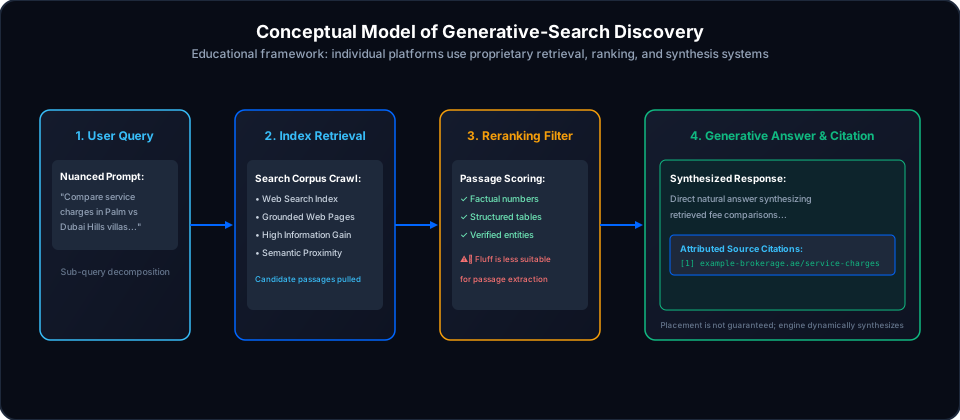
To optimize for AI search discovery, marketing teams must understand the underlying conceptual flow. The sequence: Query Decomposition → Index Retrieval → Passage Reranking → Grounded Synthesis → Attributed Citation serves as a useful conceptual educational model.
Individual platforms use proprietary retrieval, ranking, and synthesis systems. Google AI Overviews, ChatGPT Search, and Perplexity deploy distinct indexing infrastructure and scoring weights. The common denominator across all platforms is a reliance on crawlable, authoritative web pages with high factual density.
When an investor asks a conversational question, the engine retrieves candidate passages from high-authority documents that rank well for semantic relevance. Retrieved text blocks are evaluated for factual precision, entity disambiguation, and information density. Thin marketing copy and repetitive promotional text may be less suitable for precise factual passage extraction, whereas structured facts, numerical ranges, and verified entity references provide high retrieval usefulness.
2. Entity Grounding & Schema Knowledge Graph
Language models evaluate whether an organization represents a legitimate, verifiable commercial entity before recommending its perspectives on financial or legal transactions:
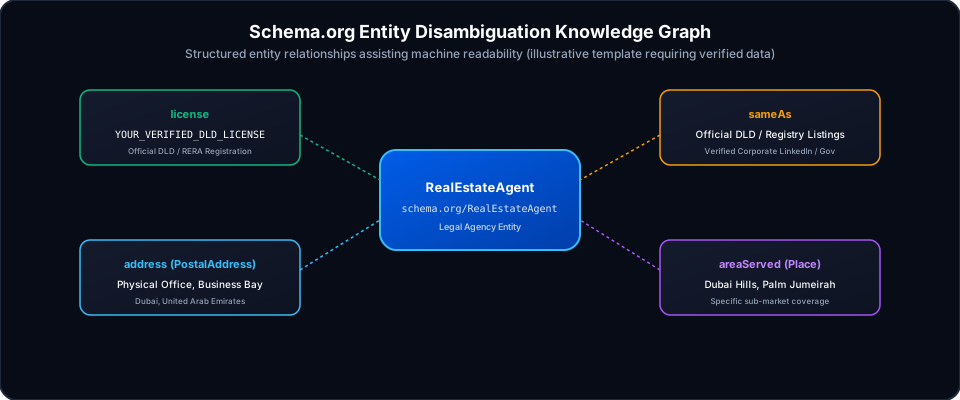
- Regulatory Disambiguation: Display clear Dubai Land Department (DLD) and Real Estate Regulatory Agency (RERA) corporate brokerage license numbers prominently across footer, about, and service pages where officially issued and verified.
- Structured Schema Graph: Implement structured JSON-LD schema (such as
RealEstateAgent) using verified real entity data only. Specify official legal name, physical office address in Dubai, verified telephone coordinates, andsameAsreferences linking exclusively to verified official DLD registers, official corporate profiles, and reputable business directories. Structured schema assists machine interpretability, but does not guarantee AI engine citations. - Author Authority & Bylines: Articles analyzing market trends, payment plans, or regulatory changes should feature verifiable author profiles detailing professional credentials, licensing history, and sector experience.
3. RealEstateAgent Schema Template (Illustrative)
Below is an illustrative template requiring verified real entity data. Organizations should populate fields with actual verified registry records:
{
  "@context": "https://schema.org",
  "@type": "RealEstateAgent",
  "@id": "https://example-brokerage.ae/#organization",
  "name": "YOUR_VERIFIED_AGENCY_LEGAL_NAME",
  "url": "https://example-brokerage.ae",
  "logo": "https://example-brokerage.ae/logo.png",
  "identifier": "YOUR_VERIFIED_DLD_LICENSE_ID",
  "license": "YOUR_VERIFIED_RERA_REGISTRATION_ID",
  "address": {
    "@type": "PostalAddress",
    "streetAddress": "Office 1402, Marina Plaza",
    "addressLocality": "Dubai Marina",
    "addressRegion": "Dubai",
    "postalCode": "00000",
    "addressCountry": "AE"
  },
  "telephone": "+9714XXXXXXXX",
  "sameAs": [
    "https://www.linkedin.com/company/your-verified-profile",
    "https://dubailand.gov.ae/en/eservices/broker-inquiry"
  ],
  "areaServed": [
    {
      "@type": "Place",
      "name": "Dubai Hills Estate"
    },
    {
      "@type": "Place",
      "name": "Palm Jumeirah"
    }
  ]
}
4. High-Information-Gain Architecture & Direct Answers
Generative models prioritize content that delivers high "information gain"—meaning the text introduces fresh, structured facts rather than repeating well-known baseline statements:
- 40–60 Word Direct-Answer Snippets: Position concise, objective summaries directly beneath question-based H2 and H3 headings to maximize clarity for users and search parsers (without implying guaranteed selection). If the heading asks about Dubai service charges, the opening paragraph should immediately state the prevailing price ranges per square foot before exploring sub-communities.
- Proprietary Data Tables: Generative crawlers excel at parsing semantic HTML tables. Presenting structured comparisons—such as historical rental yields by community, service charge schedules, or payment plan structures—improves data clarity and extraction potential, though inclusion remains subject to engine retrieval thresholds.
- Explicit Boundary Conditions: Documenting caveats, developer delivery track records, fee structures (e.g., 4% DLD transfer fee, Oqood registration costs, agency commissions), and potential risks demonstrates objectivity that aligns with search quality systems.
5. The AI Crawler & Web Indexation Matrix
A website cannot be cited by AI engines if automated crawlers encounter technical rendering barriers or robots.txt exclusions:
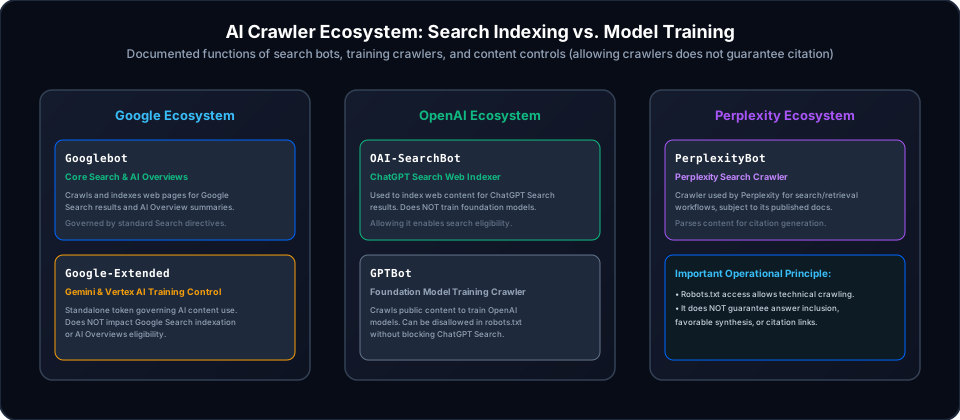
Different automated crawlers serve fundamentally different purposes:
- Googlebot: Google's primary search web crawler. It indexes content for Google Search, which serves as the underlying retrieval corpus for Google AI Overviews. Disallowing Googlebot removes the site from both standard Search and AI Overviews.
- Google-Extended: A standalone robots.txt token that allows webmasters to control whether their site content is used to train Google's Gemini and Vertex AI models. Citing official Google documentation: Google-Extended does not affect a site's indexing or ranking in Google Search, nor does it block AI Overviews.
- OAI-SearchBot: A specialized web crawler used by OpenAI specifically to index content for ChatGPT Search results. It does not train foundation models. Allowing OAI-SearchBot enables eligibility for search citation, though placement is not guaranteed.
- GPTBot: OpenAI's crawler used to collect public data for training foundation AI models. Websites can disallow GPTBot in robots.txt without impacting their presence in ChatGPT Search.
- PerplexityBot: The crawler used by Perplexity for search and retrieval workflows, subject to its published crawler documentation.
Allowing search crawlers enables technical indexability, but does not guarantee inclusion, synthesis, or citation in AI responses. Inclusion remains dynamically governed by retrieval relevance, source authority, and user prompt context.
6. What Structured Data Can and Cannot Do
| Capability Dimension | What Structured Data CAN Do | What Structured Data CANNOT Do |
|---|---|---|
| Entity Recognition | Assists search engines in connecting business name, office address, and verified licenses. | Cannot force an AI engine to prioritize your brokerage over established portals or authoritative news. |
| Answer Extraction | Makes numerical fees, schedules, and property tables easier for machine parsers to read. | Cannot guarantee passage citation if competing sources demonstrate higher authority or freshness. |
| Ranking Influence | Provides structured context that supports core web search quality evaluations. | Cannot compensate for thin, unoriginal copy, slow page speeds, or unverified claims. |
7. Conversational Query Testing Methodology
To evaluate your agency's generative search footprint, marketing teams should avoid testing only branded terms. Follow a structured testing methodology:
- Define Intent Scenarios: Test multi-layered prompts covering off-plan payment rules, community service charges, Golden Visa thresholds, and developer handover track records.
- Cross-Platform Auditing: Query identical prompts across Google AI Overviews, ChatGPT Search, and Perplexity to observe which sources are cited.
- Analyze Citation Ecosystems: Track whether answers cite developer portals, official DLD guidelines, independent brokers, or news media. Identify gaps where your agency can publish primary data tables.
8. 8-Point AI-Search Readiness Checklist for Brokerages
Server-Side Rendering (SSR/SSG): Confirm all market analysis and property pages render complete HTML without client-side JS dependency.
Robots.txt Crawler Permissions: Audit robots.txt ensuring Googlebot and OAI-SearchBot have crawl access to public research pages.
RealEstateAgent Schema Graph: Deploy validated JSON-LD schema referencing verified DLD/RERA licenses and official sameAs profiles.
Direct-Answer Formatting: Structure educational pages with clear 40–60 word answer summaries beneath question headings.
Proprietary Data Tables: Present community comparisons, historical price trends, and payment milestones in semantic HTML tables.
Verified Author Bylines: Include verifiable author biographies detailing real estate credentials and licensing background.
Bilingual Semantic Parity: Ensure Arabic and English versions maintain accurate legal terminology (Oqood, Ejari, Musataha).
Search Console Tracking: Monitor Google Search Console performance reports for impressions originating from AI Overviews.
9. Frequently Asked Questions
Does optimizing for AI Overviews replace traditional SEO?
No. Generative engines retrieve candidate information primarily from documents that already rank in top search results. Strong technical SEO, Core Web Vitals, mobile responsiveness, and high-quality link equity remain necessary prerequisites for generative search inclusion.
Can an agency guarantee citation in ChatGPT Search or Google AI Overviews?
No legitimate agency or consultant can guarantee inclusion or specific positioning in generative search responses. AI answer engines dynamically synthesize responses based on real-time retrieval and user prompt context. The objective is to maximize technical citation eligibility through entity clarity and authoritative content.
How does Google-Extended affect search presence?
According to Google's official documentation, Google-Extended is a robots.txt control specifically for managing whether site content trains Gemini and Vertex AI models. It does not control indexing or ranking in Google Search, nor does it block Google AI Overviews.
10. Technical References & Official Documentation
- • Google Search Central: Google AI Overviews & Generative AI Features Guidance
- • Google for Developers: Google-Extended Standalone Robots.txt Token
- • OpenAI Help Center: OAI-SearchBot Web Crawler & ChatGPT Search Documentation
- • Schema.org: RealEstateAgent Structured Data Specifications
- • Perplexity AI: PerplexityBot Web Crawler Documentation
Position Your Brokerage for the Future of Search
The rise of generative search does not mean the end of real estate organic acquisition; it means the end of superficial SEO tactics. Brokerages that invest in proprietary market analysis, structured data architecture, and verified entity authority will continue to capture high-intent international investors.
To upgrade your brokerage's digital infrastructure and capitalize on generative discovery, explore Asif Digital's tailored AI solutions for Dubai real estate agencies.