
Architectural Overview
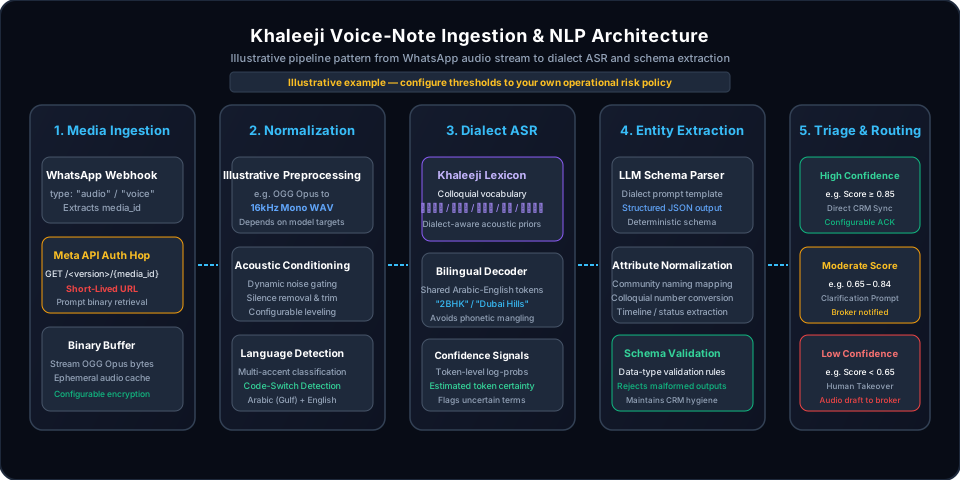
In the United Arab Emirates and broader GCC property markets, customer communication frequently occurs across conversational channels like WhatsApp. Voice notes can appear in Arabic and English property enquiries and introduce additional processing complexity compared with structured text or form submissions. Off-the-shelf speech recognition models often encounter difficulties when processing colloquial Khaleeji phrasing, intra-sentence code-switching with English real estate terms, and varying audio quality. This technical guide outlines an architectural framework for ingesting WhatsApp voice notes, preprocessing audio streams, resolving dialectal syntax, extracting schema-validated property entities, and configuring human-in-the-loop broker review workflows with illustrative confidence thresholds.
Table of Contents
1. The Khaleeji Audio Context: Conversational Enquiries in UAE Real Estate
While structured web forms and portal inquiries represent a major portion of top-of-funnel inbound marketing in the UAE, high-intent prospective buyers and investors routinely initiate conversations over WhatsApp. Voice notes can appear in Arabic and English property enquiries and introduce additional processing complexity compared with structured text or form submissions.
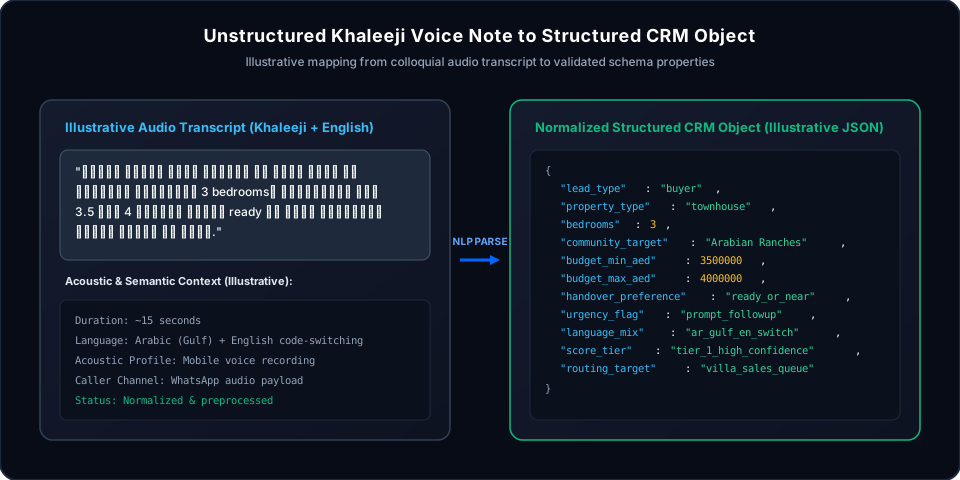
When inquiring about off-plan developments, villa communities, or secondary market availability, users often record a quick spoken message rather than typing out paragraphs of text. An illustrative voice note might sound like:
"مرحبا اخوي، يعطيك العافية. شفت إعلانكم عن تاون هاوس في المرابع العربية، بغيت 3 غرف نوم ويكون ready أو قريب التسليم، ميزانيتي بحدود 3.5 إلى 4 مليون، تواصل معاي أول ما تشوف الرسالة."
In this illustrative scenario, the speaker conveys multiple key qualification parameters in approximately fifteen seconds: property type (Townhouse), general area (such as Arabian Ranches), room count (3 bedrooms), handover timeline preference (ready or nearing completion), and indicative budget (AED 3.5M – 4.0M).
Without automated audio ingestion and dialect-aware NLP, voice notes remain opaque audio files that require manual listening by brokerage staff. Delays during peak hours or weekends can impact response velocity. To address these workflows, agencies are evaluating specialized Arabic AI systems for UAE businesses that parse inbound voice notes into structured data objects.
2. The WhatsApp Media Ingestion Pipeline: Ephemeral URLs & Webhook Handling
In architectures leveraging the Meta WhatsApp Business Cloud API, receiving an audio message triggers an inbound webhook notification containing metadata rather than the raw audio payload itself:
{
  "object": "whatsapp_business_account",
  "entry": [
    {
      "id": "WHATSAPP_BUSINESS_ACCOUNT_ID",
      "changes": [
        {
          "value": {
            "messaging_product": "whatsapp",
            "metadata": {
              "display_phone_number": "+97140000000",
              "phone_number_id": "PHONE_NUMBER_ID"
            },
            "contacts": [
              {
                "profile": { "name": "Prospective Buyer" },
                "wa_id": "971500000000"
              }
            ],
            "messages": [
              {
                "from": "971500000000",
                "id": "wamid.SAMPLE_MESSAGE_ID",
                "timestamp": "1725883200",
                "type": "audio",
                "audio": {
                  "mime_type": "audio/ogg; codecs=opus",
                  "sha256": "4b92d7f29d41cc60474ebcf4c0576391d842247653fa652399201948573210ab",
                  "id": "MEDIA_ASSET_ID",
                  "voice": true
                }
              }
            ]
          },
          "field": "messages"
        }
      ]
    }
  ]
}
To retrieve the underlying audio file, the system executes two distinct steps:
- Retrieve Temporary Media URL: An authenticated request is dispatched to the Graph API media node (e.g.
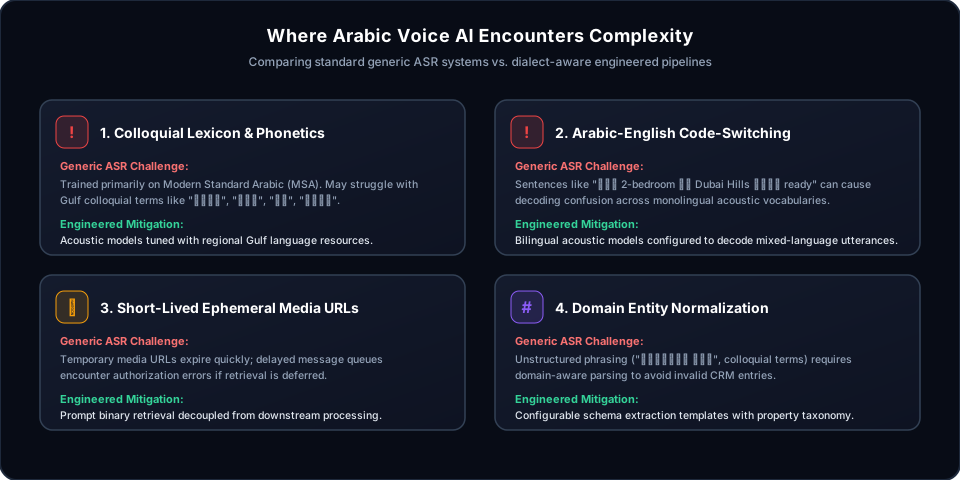
GET https://graph.facebook.com/<API_VERSION>/<MEDIA_ID>) using a system access token. Meta returns a JSON response containing an ephemeral download URL. - Prompt Binary Stream Retrieval: According to Meta's developer documentation, temporary media download URLs are short-lived and require prompt retrieval rather than deferred processing. If an asynchronous message queue experiences prolonged processing delays, deferred requests to an expired temporary URL return an authorization error. Resilient architectures decouple the retrieval step by streaming the binary bytes into an ephemeral buffer promptly upon webhook ingestion before returning an acknowledgment.
3. Audio Preprocessing: Illustrative Transcoding and Normalization
WhatsApp voice notes typically arrive in an OGG container encoded with the Opus codec (audio/ogg; codecs=opus). Many speech recognition models and acoustic decoders, however, perform optimally when fed single-channel Linear PCM WAV audio sampled at 16kHz.
Below is an illustrative preprocessing configuration demonstrating common acoustic conditioning principles using FFmpeg:
ffmpeg -i input_voice_note.ogg \
  -ar 16000 \
  -ac 1 \
  -c:a pcm_s16le \
  -af "loudnorm=I=-16:TP=-1.5:LRA=11,silenceremove=start_periods=1:start_silence=0.1:start_threshold=-50dB" \
  -y normalized_sample.wav
This example illustrates three potential preprocessing steps:
- Sample Rate Standardization: Resamples input audio to 16kHz 16-bit PCM to align with typical acoustic frame configurations.
- Loudness Normalization: Applies illustrative loudness leveling (such as EBU R128 standard) to balance low-gain recordings with high-gain vehicular audio.
- Silence Removal & Gating: Trims leading and trailing acoustic dead time to reduce unnecessary inference compute and mitigate repetitive token generation.
Note: Optimal audio conditioning parameters depend on the specific speech-to-text model, acoustic environment, and input characteristics. Teams should test preprocessing variations against their own acoustic sample baseline.
4. The Code-Switching Conundrum: Khaleeji Arabic & English Intra-Sentence Mixing
A frequent challenge in UAE commercial speech recognition is intra-sentence code-switching. In Dubai's multinational business environment, speakers routinely blend colloquial Arabic grammar with English industry terminology:
"يا الطيب، شوف لي إذا عندهم 2-bedroom في Dubai Hills يكون high-floor مع full golf course view، ويكون فيه post-handover payment plan."
When an ASR system is restricted to a monolingual Arabic dictionary, English acoustic sequences may be phonetically transcribed as distorted Arabic script. Conversely, forcing an English-only acoustic decoder typically discards the surrounding Arabic phrasing. Resolving mixed-language utterances effectively requires multilingual models or joint acoustic vocabularies capable of transitioning across character spaces mid-utterance.
5. Colloquial Khaleeji vs Modern Standard Arabic (MSA) Considerations
Many general-purpose cloud speech recognition services are trained primarily on Modern Standard Arabic (MSA / الفصحى) derived from news reports, official speeches, and formal publications. In spontaneous spoken conversation across the UAE and GCC, participants frequently use regional dialectal markers—predominantly Gulf / Emirati Arabic, alongside Saudi, Kuwaiti, and Levantine variants.
Speech-to-text accuracy varies by accent, model, audio quality, background noise, and language mix. Table 1 provides illustrative examples of dialectal phrasing that general MSA models may misinterpret without tailored vocabulary support:
| Illustrative Colloquial Phrasing | Common Contextual Meaning | Potential Generic MSA Challenge | Dialect-Aware Parsing Target |
|---|---|---|---|
| أبغى / أبي ڤيلا بالمرابع | Seeking a villa in Arabian Ranches | May misinterpret colloquial "أبغى" or drop colloquial prefixes | Intent: Purchase Enquiry | Community: Arabian Ranches |
| كم واصل السوم عليها؟ | Inquiring on current highest offer/bid | May confuse regional real estate auction term "السوم" | Intent: Resale Bid / Offer Status Inquiry |
| العقار مب جاهز صح؟ | The property is not ready, correct? | May misinterpret colloquial negation "مب" | Attribute: Completion_Status = Off-Plan / Under-Construction |
| مليونين ونص كاش | 2.5 Million AED liquid capital | May fail to parse spoken fraction into numeric integer | Budget: 2,500,000 AED | Payment_Method: Cash |
| طرش لي البروشور على الواتساب | Send the brochure via WhatsApp | Colloquial Gulf verb "طرش" (send) unrecognised in MSA | Action: Collateral Dispatch Request |
Note: The mappings above are illustrative parsing targets demonstrating dialectal variety, not universal linguistic equivalencies. Property and community name normalizations should be validated against agency taxonomies.
6. Extracting Structured Real Estate Entities from Unstructured Audio
Once speech is transcribed, transforming raw text into structured database fields requires a schema-driven entity extraction step. Below is an illustrative schema representation showing how extracted parameters can be organized into validated JSON properties:
{
  "event_id": "evt_sample_1725883215",
  "source": "whatsapp_voice_note",
  "caller": {
    "formatted_phone": "+971500000000",
    "name": "Prospective Buyer"
  },
  "acoustic_context": {
    "language_mix": "Arabic (Gulf) + English",
    "transcription_confidence_tier": "high"
  },
  "raw_transcription": "مرحبا اخوي، بغيت استفسر عن تاون هاوس في المرابع العربية، 3 bedrooms، الميزانية حول 3.5 إلى 4 مليون، ويكون ready أو قريب التسليم، كلمنا ضروري لو سمحت.",
  "extracted_entities": {
    "intent": "property_purchase",
    "property_type": "townhouse",
    "bedrooms": 3,
    "target_community": "Arabian Ranches",
    "financials": {
      "currency": "AED",
      "budget_min": 3500000,
      "budget_max": 4000000
    },
    "timeline": {
      "urgency": "high",
      "handover_preference": "ready_or_near_handover"
    }
  },
  "workflow_routing": {
    "suggested_tier": "tier_1_automated_assignment",
    "assigned_specialist_group": "villa_sales_team"
  }
}
By converting spoken vernacular into explicit data attributes, the inquiry can be routed into standard sales pipelines without requiring an agent to transcribe recordings manually. For broader conversational automation context, explore our analysis of WhatsApp chatbot architecture in Dubai.
7. Illustrative Confidence Scoring & Configurable Escalation Thresholds
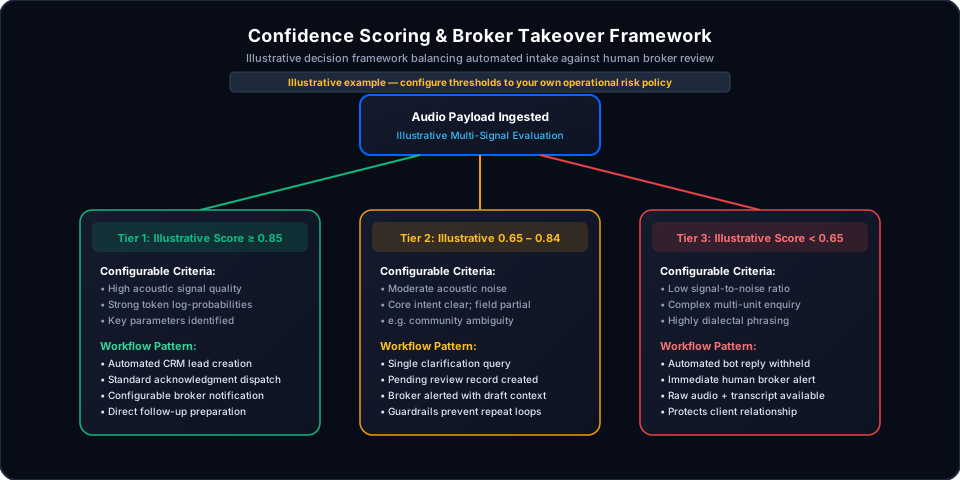
In high-value real estate transactions, sending inappropriate automated responses due to transcription errors can damage prospect relationships. Systems can be configured with multi-signal confidence evaluations combining acoustic uncertainty and schema completeness.
The following weighting model represents an illustrative scoring example rather than an empirically validated formula:
- Acoustic Token Certainty (Illustrative 40% Weight): Average token log-probabilities provided by the speech decoder.
- Entity Schema Completeness (Illustrative 35% Weight): Verification that critical qualification parameters (e.g. location, property type, budget indicator) were identified.
- Semantic Intent Clarity (Illustrative 25% Weight): Evaluation confirming the message represents an authentic property inquiry rather than ambient noise or unintentional recording.
Based on such scoring criteria, systems can implement illustrative configurable thresholds to govern automated triage:
Automated Dispatch
Audio signal is clear, dialect intent is unambiguous, and key parameters are identified. The lead record can be created in the CRM, assigned to a specialist queue, and an acknowledgment dispatched.
Clarification Loop
Core intent is recognized, but a secondary parameter is ambiguous. Configurable workflows may send a single polite clarification query while flagging the record for broker review.
Human Broker Takeover
Acoustic quality is degraded or phrasing is complex. Automated bot messaging is withheld, and the recording is routed directly to human agents for manual review.
Operational parameters: Production deployments should calibrate threshold numbers and weighting formulas against their own historical validation data and business risk preferences.
8. Human-in-the-Loop Broker Takeover & Safety Routing Patterns
The objective of voice-processing automation in real estate is to reduce administrative data-entry delays, not to replace the relationship-driven counsel of experienced property consultants.
Brokerage architectures can implement configurable human takeover patterns when low-confidence scores or complex inquiries are detected:
- Automated Messaging Suspension: Bot replies for the conversation thread are temporarily suppressed to avoid conflicting with manual outreach.
- Broker Notification Dispatch: The system can push the original audio recording and preliminary draft transcription to assigned team queues (such as CRM notifications, internal messaging groups, or dispatch alerts).
- Direct Outreach Enablement: Notifications can provide links enabling consultants to review context before placing a direct phone call or replying via WhatsApp.
- Audit Logging: Event timestamps from inquiry receipt to broker review can be logged in the CRM to provide visibility over response workflows.
9. UAE Data-Protection & Governance Considerations
Organizations deploying voice-processing systems should design their data flows to support the organization's requirements under UAE Federal Decree-Law No. 45 of 2021 on Personal Data Protection (PDPL), subject to internal legal and governance review:
- Regional Cloud Hosting Options: Organizations can evaluate hosting transcription and database components within UAE regional cloud zones to align with internal data residency preferences.
- Ephemeral Audio Handling: Audio payloads should be managed under appropriate retention schedules, with policies defining whether raw audio is purged after verification or retained for audit.
- Encryption & Access Controls: The architecture can be designed to support transport-layer encryption (such as TLS), encrypted storage at rest, and role-based access control (RBAC), helping ensure audio recordings and transcriptions are accessible only to authorized personnel.
- Consent & Transparency: Organizations should ensure that customer terms and privacy notices inform users that communications may be processed to fulfill property service requests.
10. Build vs. Buy: Custom Engineered Pipeline vs Off-the-Shelf SaaS
Brokerage leaders evaluating conversational audio intake typically compare commercial off-the-shelf software against customized engineering integrations. Table 2 outlines architectural tradeoffs:
| Dimension | Generic SaaS Chatbot Solutions | Custom Engineered Integration |
|---|---|---|
| Audio Ingestion Support | Frequently limited to text inputs; audio handling varies | Configurable binary streaming and media format preprocessing |
| Dialect Adaptability | Often reliant on general MSA acoustic models | Can incorporate custom regional lexicons and dialect resources |
| Code-Switching Support | Variable performance on mixed Arabic-English sentences | Configurable bilingual acoustic decoders |
| CRM Data Hygiene | Standard field mapping; custom entity parsing requires workarounds | Direct schema validation aligned with brokerage database structures |
| Governance & Hosting | Subject to multi-tenant provider cloud locations | Deployable to dedicated tenant environments and designated cloud regions |
11. 10-Point Technical Readiness Checklist for Brokerages
Meta Business Account Verification: Confirm authorized Meta WhatsApp Business Solution Provider (BSP) or Cloud API credentials.
Prompt Media Ingestion: Deploy webhook handlers that retrieve temporary media URLs promptly before expiration.
Audio Preprocessing Pipeline: Configure audio conditioning pipelines converting inbound voice formats to target model parameters.
Dialect Evaluation Baseline: Test speech recognition models against real-world sample recordings of local accents.
Code-Switching Support: Verify transcription behavior on mixed Arabic and English real estate terminology.
Community Taxonomy Mapping: Map colloquial Arabic community references to standardized CRM project identifiers.
Configurable Confidence Triage: Establish threshold policies for automated routing versus broker notification.
Broker Takeover Workflow: Verify routing pathways delivering audio and draft context to consultants when needed.
Data Retention Controls: Define data lifecycle policies for purging or archiving audio files post-transcription.
CRM Integration Testing: Validate end-to-end record creation across leads, activities, and communication histories.
12. Frequently Asked Questions
Can an AI model guarantee 100% accuracy on Arabic dialects?
No speech recognition system can guarantee 100% transcription accuracy across conversational dialects. Speech-to-text accuracy varies by accent, model, audio quality, background noise, and language mix. Engineering best practices emphasize deploying dialect-conditioned models alongside multi-signal confidence evaluations and human broker review mechanisms whenever ambiguity is detected.
How fast do automated voice pipelines process audio messages?
Processing time varies by model, file duration, infrastructure, queueing, and provider configuration. In streaming microservice architectures, end-to-end ingestion, transcription, and entity extraction are typically designed to execute asynchronously without blocking webhook receipt.
How are inquiries handled outside of normal office hours?
Workflows can be configured based on agency operational guidelines. Systems can record structured inquiries in the CRM at any time and either send a standard polite confirmation or queue the notification for team follow-up during operational business hours.
13. Technical References & Official Documentation
- • Meta for Developers: WhatsApp Cloud API Media Object & Temporary Download URL Behavior
- • IETF: RFC 7845: Ogg Encapsulation for the Opus Audio Codec
- • ITU-R: Recommendation ITU-R BS.1770: Audio Program Loudness Measurement
- • UAE Legislation Portal: Federal Decree-Law No. 45 of 2021 on Personal Data Protection (PDPL)
Explore Dialect-Aware Conversational Architecture
As conversational messaging channels continue to expand across UAE commerce, handling multi-lingual and dialectal communication with high reliability becomes a critical capability for property consultancies.
To audit your agency's lead-intake infrastructure or explore custom conversational integrations, review Asif Digital's specialized Arabic AI systems for UAE businesses and WhatsApp chatbot architecture in Dubai.